

At the World Humanoid Robot Games in Beijing, a robot sprinted 100 meters in 9.39 seconds—beating Usain Bolt’s world record. Minutes later, the same robot crashed into a barrier, broke apart at the waist, and burst into sparks. This spectacle captures the state of humanoid robotics perfectly: breathtaking progress in controlled settings, followed by spectacular failure in anything resembling real life.
For all the billions poured into humanoid development, these machines remain fundamentally unable to « survive » in the messy, unpredictable real world. The reasons go far beyond battery life. Here’s why.
The Dexterity Crisis: Why Robots Can’t Handle a Matchbox
Rodney Brooks, the MIT professor emeritus who co-founded iRobot, has spent decades building robots. His verdict on current humanoids is blunt: the pursuit of general-purpose humanoid assistants is « pure fantasy thinking ».
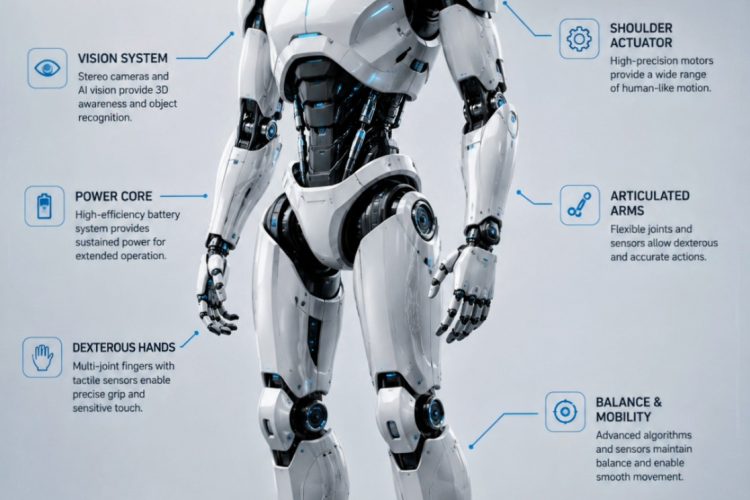
The core problem is dexterity—specifically, the inability to replicate human touch. Brooks points to a biological reality the tech world is ignoring: the human hand contains 17,000 mechanoreceptors, with 1,000 in each fingertip alone, capable of detecting everything from gentle indentation to skin stretching.
Here’s the kicker: companies like Tesla and Figure are training their robots using video—workers wear cameras to record tasks, then AI models imitate the motions. This works for speech recognition and image processing because there’s vast data. But touch data doesn’t exist. We have no tradition of capturing, storing, or replaying touch sensations.
Brooks demonstrates this with a simple experiment: when a person’s fingertips are anesthetized, picking up a match and lighting it—normally a 7-second task—stretches to nearly 30 seconds of fumbling. Without touch, the fingers slip, the grip fails, the task unravels.
If humans can’t do it without touch, why expect robots to?
The dexterity gap is so severe that Brooks predicts « we are more than ten years away from the first profitable deployment of humanoid robots even with minimal dexterity ». And even then, he argues successful robots will likely be non-humanoid: wheels instead of legs, multiple arms instead of two.
The Physics of Falling: Dangerously Unstable Machines
Beyond dexterity lies an even more immediate problem: these robots are dangerous.
Brooks warns people to stay at least 3 meters (9 feet) away from any full-size walking robot. The reason is basic physics. Current humanoid robots maintain balance by pumping massive amounts of kinetic energy into their systems. When they fall—and they fall often—that stored energy becomes a weapon.
Double the size of a robot, and its mass increases by a factor of eight. A falling full-size humanoid has eight times the kinetic energy of a half-size version. That rapidly accelerating metal limb can cause severe injury or worse.
The numbers are sobering. In one recorded incident, a Figure 02 robot—valued at $390 billion—lost control during testing and punched a stainless steel refrigerator, leaving a 6mm dent. That impact was two times the force needed to fracture an adult human skull. The punch occurred inches from a human worker.
Across all industrial robots (not just humanoids), over 60% of workplace injuries are caused by « accidental activation »—the machine moves when it shouldn’t. With a 200-pound walking robot that makes AI decisions in real time, that risk multiplies.
These aren’t hypotheticals. A Tesla factory worker was knocked unconscious and pinned by a robot in 2025. A robot in a California restaurant went haywire mid-performance, scattering dishes and sauces across diners’ tables while staff struggled to shut it down via smartphone app because there was no physical emergency stop button.
The Energy Crunch: Charging for Hours to Work for Minutes
Even if robots could handle delicate tasks and avoid falling, they’d still be tethered to charging stations.
A 70kg humanoid robot consumes 200–300 watts just to stand still—that’s several high-power desktop PCs running, doing nothing but fighting gravity. When it starts, stops, or turns, power spikes dramatically.
The math is brutal: a robot might charge for two hours to work for fifteen minutes. In controlled lab conditions, some claim 4–5 hours of runtime. In the real world? 1–2 hours is considered good.
Why? The batteries are limited by the robot’s own compact frame—most carry just 100-150 watt-hours total. And the robot’s « brain » (AI models) and « cerebellum » (movement algorithms) are constantly consuming power alongside the motors.
During the 2025 Beijing half-marathon for humanoids, robots were regularly pulled off the track for emergency battery swaps—a « hot swap » surgery performed by engineers mid-race. This « buy two, charge one » workaround works in factories but makes no sense for homes, where users expect a device to last all day like a smartphone or a Roomba. As one engineer put it: achieving that consumer experience is « a long, long road ».
The Bright Spots: ROI and Promising Use Cases
Despite these challenges, humanoids are finding footholds—but only in highly controlled environments.
Companies like Ubisoft are deploying robots in factories for (moving, sorting, and loading/unloading)—repetitive tasks with clear boundaries and no human proximity. With a price tag under $500,000 for a complete solution, ROI in developed markets is 18-24 months.
And costs are plummeting. Goldman Sachs reported humanoid manufacturing costs dropped 40% in a single year, from ~$85,000 in 2023 to ~$25,000 in 2025. IDTechEx forecasts the average selling price will fall from $114,700 in 2024 to ~$37,000 by 2030.
In high-utilization industrial scenarios, payback periods could shrink to 6 months by 2026. That’s why automotive and logistics are the real early markets—not homes, not restaurants, not nursing.
The Bottom Line
Humanoid robots can sprint, dance, and grab headlines. They cannot fold laundry reliably, pick up a match without fumbling, or operate safely within arm’s reach of a human. They consume energy like a small appliance while delivering the output of a clumsy toddler.
The vision of a general-purpose robot assistant that handles your chores, cares for your elderly parents, or serves your dinner is not years away—it’s likely a decade or more, if it ever arrives. The robots that will succeed in the near future will be purpose-built for specific tasks, will avoid legs and human-like hands when possible, and will be kept far away from people.
As Brooks put it: « A lot of money will have disappeared, spent on trying to squeeze performance, any performance, from today’s humanoid robots. But those robots will be long gone and mostly conveniently forgotten. »